

Experimental Process and Results
Fiber Selection
The wetting test aims to study the absorbability of natural fibers with a binder, good wetting enhances improve the properties of the composite material.
Procedure : In this procedure, the fibers are the independent variable while the dependent variable is the unsaturated polyester resin
1. Prepare natural fibers with uniforms dimensions
2. Pour a certain weight amount of unsaturated polyester resin onto each type of fiber.
3. Allow the resin absorb on the fiber for a specific time.
4. Observe the wetness of the fibers.


weaving process
1. Wetting Test


Pineapple fiber, banana fiber, sisal fiber, and water hyacinth showed good wetting properties. However, these fibers need to be woven, which complicates their use in sheet formation. In contrast, hemp sack is the most effective option, providing good properties and being more user-friendly when combined with polyester resin for making artificial nests.
2. Mechanical Test
Sample Preparation Steps
Procedure:
-
Mix resin and natural filler such as clay to a certain consistency.
-
Prepare the mold by placing the natural fibers on a glass plate coated with mold release wax.
-
Mix the mixture from (1) with hardening agents and catalyst.
-
Pour the mixed unsaturated polyester resin into the mold and spread it evenly using a roller.


5. Allow the sample panel to cure until it hardens.
6. Post curing the sample panel then cool down to ambient temperature
7. Cut the sample panel to the required size according test standard.

Sample for bending test

Sample for impact test
2.1 Bending Test
The bending test is a materials testing method used to evaluate a material’s ability to resist bending and deformation.
Procedure:
-
Select a sample and prepare it for testing.
-
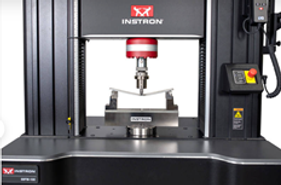
Install the grips and load cell.
-
Put the sample between two support pins.
-
Use a load to bend the sample.
5. Continue the test until the sample breaks



Experimental Results :
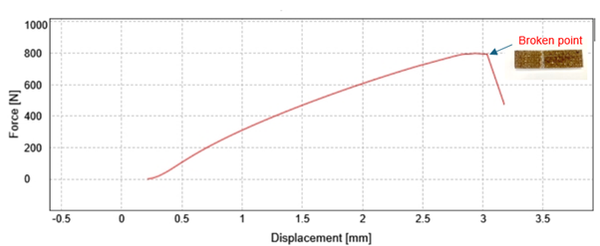

The 3-point bending test revealed that different types of natural fibers displayed varying max load and flexural strength. Among the tested fibers, the composite materials made from hemp sack and pineapple fiber demonstrated greater flexural strength compared to the other fibers tested.
2.2 Impact Test
An impact testing machine is used to assess the resistance of a material to rapid loads under varying weights and height conditions.
Procedure:
-
Place the sample between a die and a punch on the impact testing machine.
-
Adjust the height to 25cm. to prepare for the release of a 1 kg. weight.
-
Release the grip to allow the weight to fall onto the sample.
-
Examine the impact area of any cracks in the sample.
-
Repeat the procedure on the same sample at greater heights of 40cm. and 50cm.

Experimental Results :

The figure shows the impact test results of composite specimens prepared from various natural fibers.
- Pineapple fiber, sisal fiber, banana fiber, and water hyacinth demonstrated good results in terms of impact resistance, while hemp sack and jute fiber exhibited poor impact resistance.
A rating of each natural fiber is as follows

Although the hemp sack demonstrated fair impact performance, the bending property results were good. Additionally, hemp sacks are in sheet form and are more cost-effective than other natural fibers. As a result, hemp sacks were selected for further study.
According to impact test result mentioned above, additional experiments were conducted to examine the effect of the number of fiber layers.

Experimental Results :
The results showed that when the number of layers of hemp sacks were increased from 2 to 6, 8, and 10 layers, the impact resistance can be improved. Therefore, 6 layers of hemp sacks were selected to create artificial nest.

Total weight of artificial nest is 36kg.
3. Weathering Test
The QUV durability test, also known as the QUV accelerated weathering test, is a test that is used to assess a product’s resistance to UV light, moisture, and heat.
Procedure:
-
Open QUV chamber
-
Place the sample in QUV chamber
-
Close QUV chamber
-
Turn on and choose cycle B (UV 4hours, condensation 4hours)
-
Start record, the sample will be taken out from QUV chamber every 500 hours.
-
Observe the appearance of the sample after accelerating such as discoloration, chalking, or cracking.


Composite pieces are tested for durability using an accelerated weathering test : QUV/SE UVB313EL model, ASTM G154 in a QUV tester. and examine the appearance, chalking, cracking, impact, and bending every 500 hours, using glass fiber epoxy composite as a benchmark.
Experimental results:

4. Ventilation Test
In the test, the material used to build the artificial bird's nest will be studied to see how it affects the temperature inside, heat accumulated, and humidity in the bird nest.

Procedure
-
Place all 3 artificial bird nests outdoors at a height of 120 cm to ensure they receive full sunlight without any obstructions. The front of the artificial bird's nest is oriented toward the south. Ensure that all artificial nests are positioned so they do not block each other's sunlight and that all 3 nests will be exposed to direct sunlight throughout the entire day.
-
Place a hygrometer in the center of the artificial bird nest and another one outside to collect data simultaneously.
-
Collect temperature and humidity data every 1 hour for 1 month.

Experimental results:

From the graph above, the results are:
-
Starting at 7:30 AM, the temperature outside and inside the bird nest will gradually increase, reaching its highest point at 2:30 PM each day.
-
After 2:30 p.m., the temperature outside and inside the nest gradually decreases. The temperature becomes constant at 9:30 p.m.
-
After 2:30 p.m., the heat accumulated inside the bird's nest gradually releases, causing the internal temperature to decrease.

From the monitor data of temperature and %humidity inside bird nest from 3-6 Feb 2025, we found that
1. At night, the temperature inside all three types of bird nests is similar to the outside temperature.
2. During the day, the temperature inside the bird nests of various types will differ from the outside temperature
-
A comparison of bird nests made from composites both with and without air vents compared with bird nest made of wood revealed that the maximum daily temperature in the composite bird nests was 1-2 °C higher than in the wooden bird nests.
-
A comparison of bird nests made from composite materials, those with air vents had an internal temperature approximately 1°C lower than those without air vents.
-
The average temperature in bird nests from composite with air vents was about 1˚C higher than wooden bird nests.
Results
The study proved hemp sacks to be a sustainable and long-lasting alternative to glass fiber. To validate these findings, ten artificial hornbill nests made from this composite were constructed and installed on Yao Noi Island, Phang Nga Province, Thailand, during the recent breeding season (February to May 2025).
